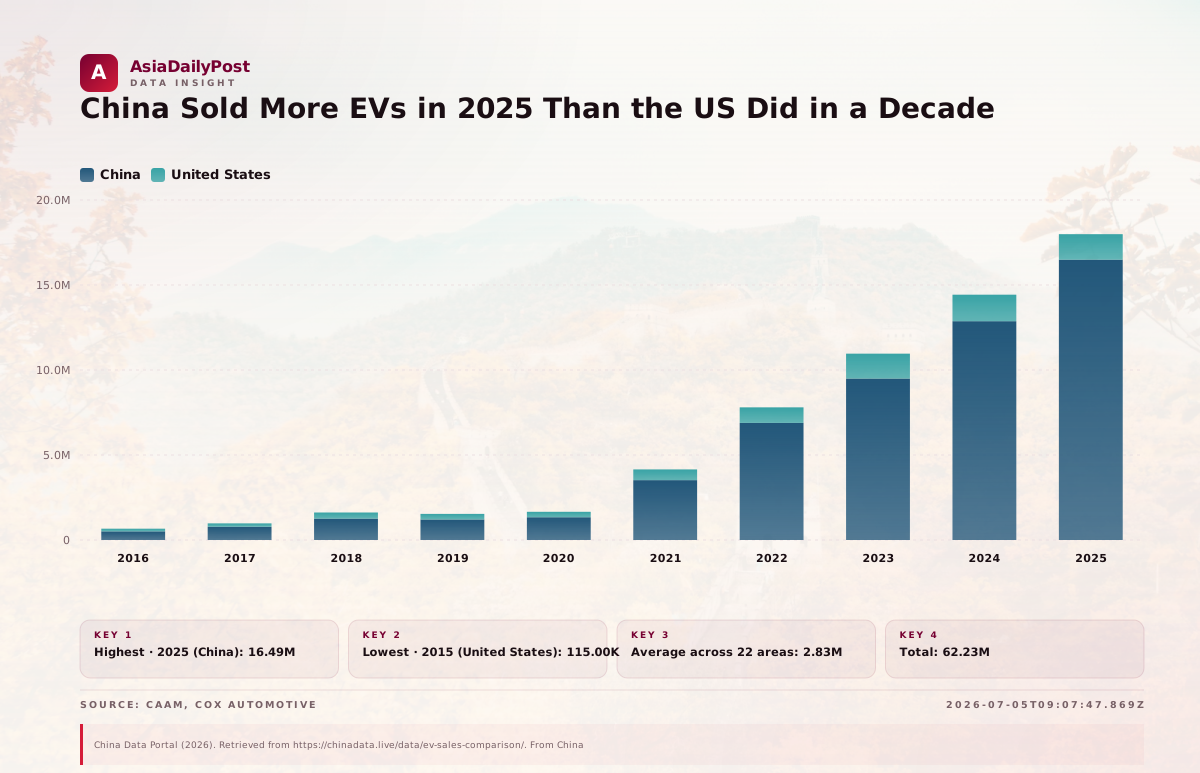
China sold 16.49 million electric vehicles in 2025, while the United States logged its weakest year of the past decade at 115,000 units in 2015 — a gulf that defines the current state of the global EV race.
Top of the chart: China's runaway lead
After breaching the one-million mark in 2018, Chinese EV sales accelerated sharply, reaching 3.52 million in 2021 and 6.89 million in 2022. The 2025 tally of 16.49 million units is larger than the entire US automotive market across all powertrains and represents a 28% year-on-year increase.
The other end: a US market losing momentum
American EV sales have yet to clear 1.6 million annually. After peaking at a 1.56 million units in 2024, deliveries slipped to 1.5 million in 2025 — a 3.8% drop. The US share of the two-country total shrank to just 8.3%, down from 11% in 2024 and 26% in 2015.
What separates the two
Policy support, domestic battery supply chains, and a price ladder that reaches below $10,000 in China explain much of the divergence. The US, by contrast, relies on a narrow lineup of premium vehicles with tax credits that face constant political revision. While China added more than 3.6 million units in a single year, the US lost ground, widening a gap that now stands at 15 million units annually.
- 2015: China 331,000; US 115,000
- 2018: China 1,256,000; US 361,000
- 2020: China 1,337,000; US 322,000
- 2022: China 6,887,000; US 916,000
- 2024: China 12,870,000; US 1,560,000
- 2025: China 16,490,000; US 1,500,000
With China now exporting EVs at scale to Southeast Asia, Europe, and Latin America, the 2025 data suggests the competition is no longer about who leads in sales, but whether the rest of the world can build a counterweight before the gap becomes permanent.
Source: CAAM, Cox Automotive · 2026-07-05T09:07:47.869Z