China ended 2025 with 4.84 million 5G base stations, blanketing every prefecture-level city. But the annual rush of new installations is finally easing, leaving operators with a different problem: getting consumers and enterprises to use all that capacity.
Key findings
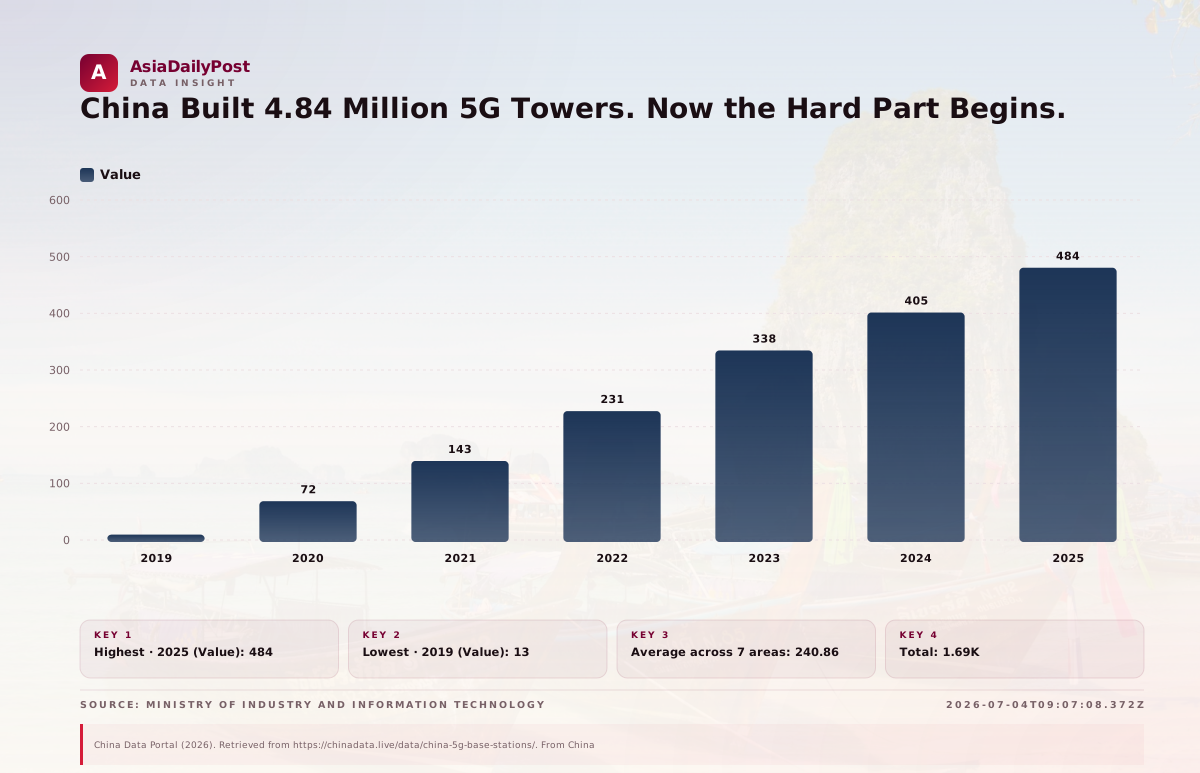
- Starting point: In 2019, just 130,000 5G base stations existed across the country.
- End-2025 tally: The network has swelled to 4.84 million stations, roughly 37 times the 2019 figure.
- Coverage achievement: Every prefecture-level city now has 5G, according to the Ministry of Industry and Information Technology.
- Per-capita density: China averages 34.4 stations per 10,000 residents, a metric still modest in global comparison.
- Growth deceleration: Annual additions peaked at 1.07 million in 2023, then eased to around 790,000 in 2025.
From coverage to uptake
The raw numbers from the Ministry of Industry and Information Technology show a network that has moved from frantic construction to mature maintenance. After peaking at 1.07 million new stations in 2023, annual additions dipped to 670,000 in 2024, then recovered marginally to 790,000 last year. The slowdown reflects both a saturated urban market and a shift in operator investment priorities.
Even with the world’s largest 5G network, China’s per-capita density of 34.4 stations per 10,000 people reveals lingering unevenness between dense coastal cities and vast inland regions. Industry executives increasingly stress that the challenge is not more base stations, but making the ones already built profitable through industrial applications, from remote mining to autonomous ports.
Whether the next growth engine comes from smart factories or from consumer demand for faster mobile video remains an open question. What’s clear is that the era of simply adding more racks every quarter is over.
Source: Ministry of Industry and Information Technology · 2026-07-04T09:07:08.372Z