China Data Portal (2026). Retrieved from https://chinadata.live/data/battery-production-china-vs-world/. From China
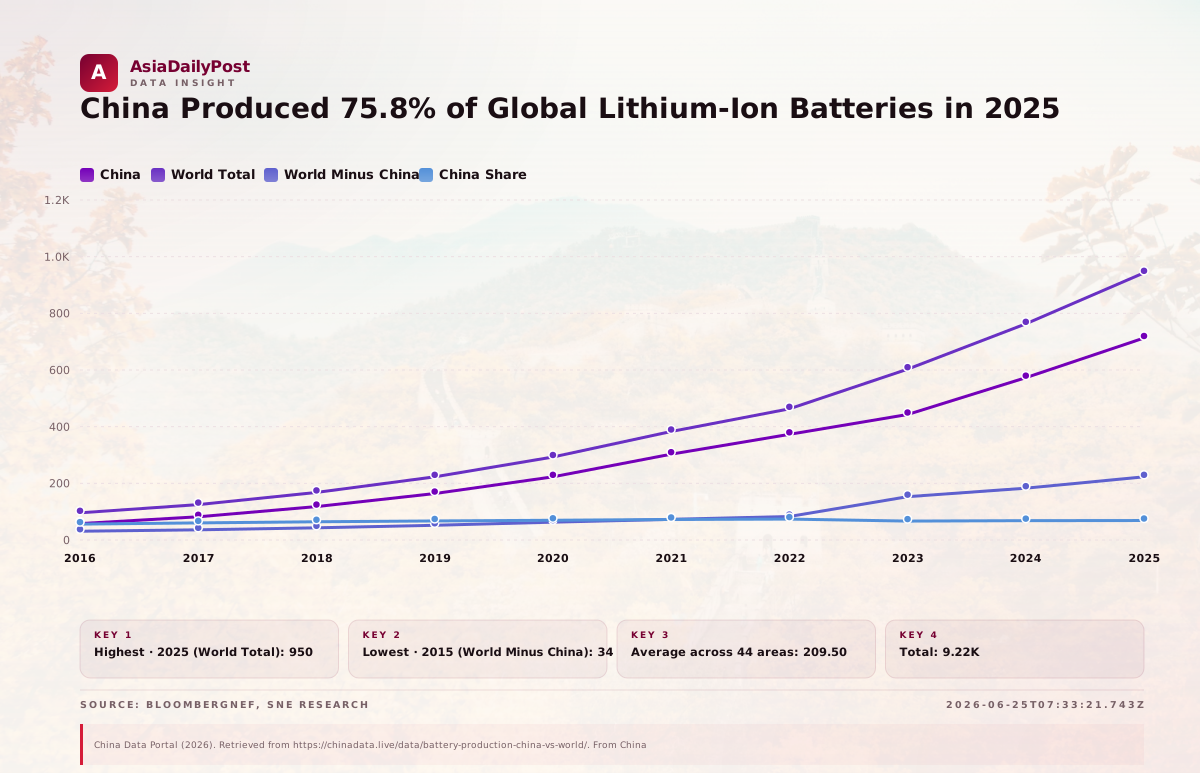
China’s control over global lithium-ion battery production has deepened dramatically in the past decade. According to data compiled by BloombergNEF and SNE Research, the country manufactured 720 gigawatt-hours (GWh) of batteries in 2025, capturing 75.8% of the world’s total of 950 GWh. Back in 2015, Chinese output was just 47 GWh and its share stood at 58%.
A Decade of Unstoppable Growth
Between 2015 and 2025, China’s annual production capacity surged more than 15-fold. The compound annual growth rate over the period exceeded 31%, far outpacing the global average of about 27%. The country’s share of global output steadily climbed, peaking at 80.9% in 2022, before a slight dip to 73.8% in 2023 and a recovery to 75.8% by 2025. That dip likely reflects a temporary slowdown in domestic electric-vehicle subsidies coupled with a ramp-up of battery gigafactories in Europe and North America. Still, the rebound shows how quickly China can scale when policy priorities shift.
The Rest of the World Falls Further Behind
The "rest of world" series tells a more sobering story. Non-Chinese production grew from 34 GWh in 2015 to 230 GWh in 2025—a healthy 6.8-fold increase. But the absolute gap between China and everyone else ballooned from just 13 GWh in 2015 to 490 GWh in 2025. In 2015, China had a 13 GWh lead; by 2025, it was producing more than three times the combined output of all other countries. Even with policy-driven attempts in the US and EU to build domestic supply chains, the scale gap remains enormous.
Why This Concentration Matters
Lithium-ion batteries are the backbone of the energy transition, powering electric vehicles and grid-scale storage. China’s dominance is rooted in years of state-backed investment, control over critical mineral processing, and a sprawling network of gigafactories. For global automakers, it means battery procurement is overwhelmingly tied to Chinese suppliers, raising supply-chain risks. While new plants outside China are coming online, the data shows that the rest of the world would need to add roughly 500 GWh of additional annual capacity just to match China’s 2025 output—a capital-intensive challenge that cannot be solved quickly.
Looking Ahead
The trajectory suggests China will continue to hold an outsized role, though its share may stabilize around 75% as foreign investments mature. What the headline numbers don’t capture is utilization rates or technology mix, but the raw capacity figures make one thing clear: for the foreseeable future, the world’s batteries will be made in China. The data covers nameplate production capacity and does not reflect actual factory utilization or sales volumes, yet the trend underscores an undeniable structural advantage that is likely to persist well beyond 2025.
Source: BloombergNEF, SNE Research · 2026-06-25T07:33:21.743Z