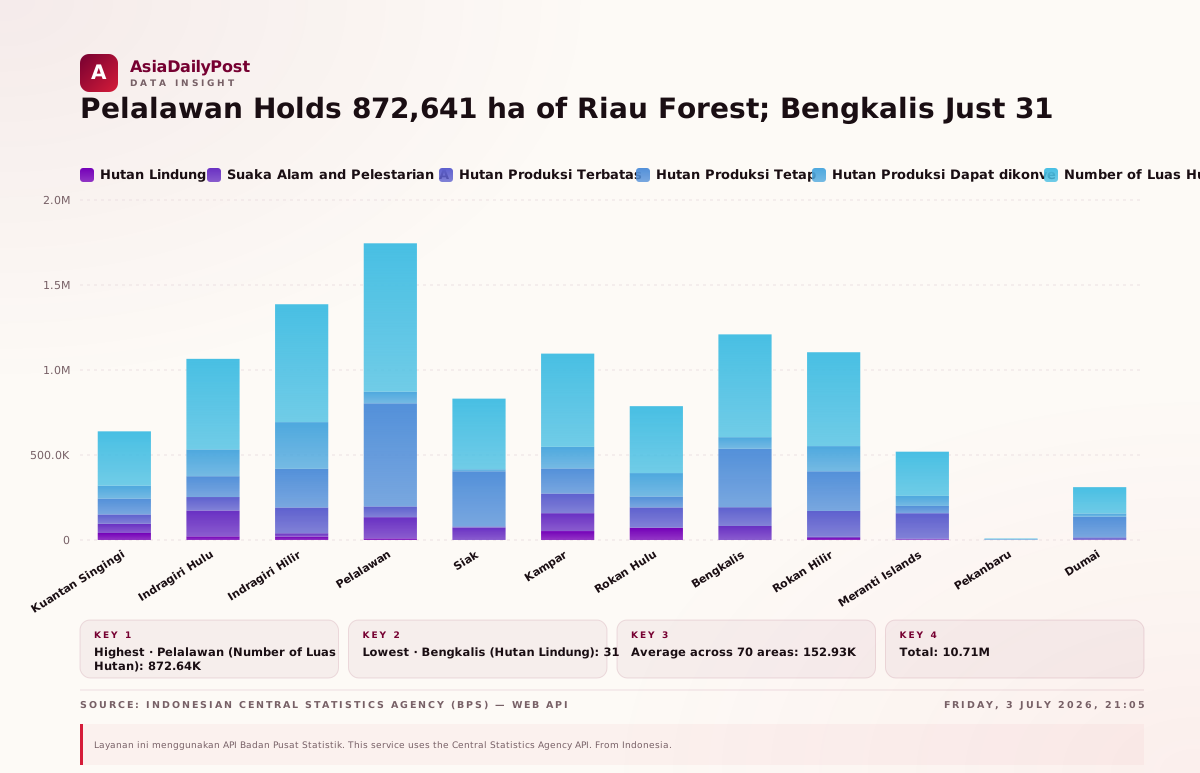
The gap between Riau’s forest-rich interior and its coastal regencies could hardly be starker: Pelalawan recorded 872,641 hectares of forest and conservation area in 2022, while Bengkalis managed just 31 hectares of protected forest — a margin of more than 28,000-to-1, according to BPS data.
The heavyweight
Pelalawan’s position rests on a diverse portfolio: 606,818 ha of permanent production forest, 125,025 ha of nature reserves and sanctuaries, and smaller allocations of limited and convertible production forests. The regency’s total of 872,641 ha makes it the single largest holder among the province’s 70 measured forest-and-conservation categories.
Indragiri Hilir follows at 693,380 ha, while Kampar and Rokan Hilir total 548,201 ha and 552,279 ha respectively. Even the Meranti Islands, an archipelago district, still records 259,756 ha.
The smallest plots
At the opposite end, Bengkalis posted the smallest protected-forest footprint — a 31-hectare plot classified as hutan lindung. Siak and Pekanbaru registered similarly tiny figures at 79 ha and 577 ha respectively, underlining how urban and plantation-heavy zones have pushed designated forestland to the margins.
The provincial mix
Across all 12 regencies and cities, the combined forest and conservation area reached 10.7 million hectares, with the average data point — one forest-type-by-regency entry — at roughly 152,900 ha. The dataset covers six land-use categories: protected forest, nature reserves, limited production forest, permanent production forest, convertible production forest, and the aggregate total.
- Leader: Pelalawan — 872,641 ha
- Runner-up: Indragiri Hilir — 693,380 ha
- Lowest: Bengkalis — 31 ha (protected forest)
- Average: 152,928 ha per recorded entry
- Total: 10,705,006 ha across 70 categories
The figures highlight that forest designation remains heavily concentrated in a few inland regencies, while many coastal and urban areas retain only residual conservation land. As infrastructure and plantation demands build, the question is whether pockets like Bengkalis’s 31-hectare protected patch can survive the next wave of development.
Source: Indonesian Central Statistics Agency (BPS) — Web API · Friday, 3 July 2026, 21:05