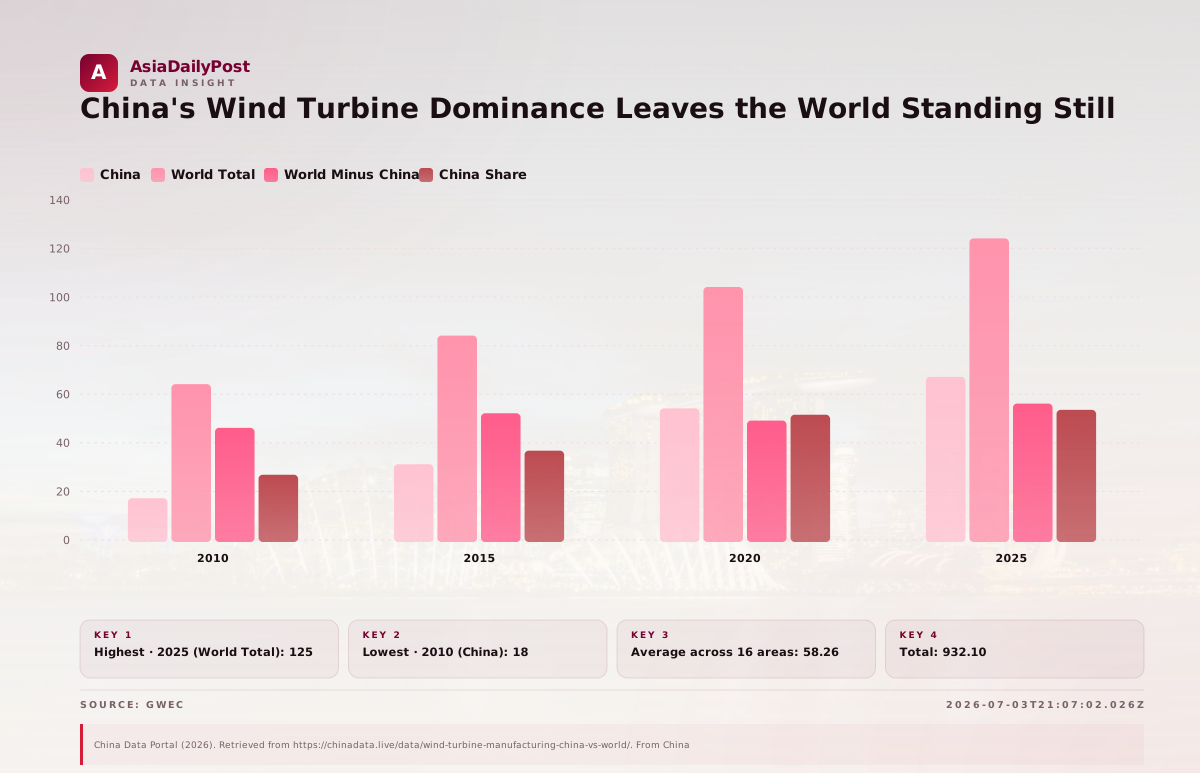
In 2025, China produced 68 gigawatts of wind turbine manufacturing capacity — more than half the global total for the first time. The rest of the world, combined, managed just 57 GW.
Key findings
- Global peak: Total world capacity hit 125 GW in 2025, the highest in the dataset.
- Starting point: China’s 18 GW in 2010 was the smallest value recorded.
- Share surge: China’s slice jumped from 27.7% in 2010 to 54.4% in 2025.
- Rest-of-world inertia: Capacity outside China crawled from 47 GW to 57 GW over 15 years.
- Average pull: The 16 data points average 58.3 GW, heavily skewed by China’s late acceleration.
A supply chain in one country
The gap between China’s 68 GW and the ex-China total of 57 GW isn’t just a number — it’s a picture of a global industry that has stopped growing anywhere else. Since 2015, capacity outside China has added exactly 4 GW, a trickle compared with the 36 GW China tacked on over the same stretch. For utilities and developers from Berlin to Texas, this means the factories building the turbines they order are overwhelmingly concentrated in a single country.
The flatlining of non-Chinese capacity also suggests that Beijing’s industrial policies — cheap land, state-backed loans, and a domestic renewables mandate — have created a cost floor that competitors cannot match. While the world total climbed to 125 GW, nearly all the upward movement came from China crossing the 50% threshold after 2020, a shift that coincided with a global scramble for clean energy supply chains ahead of climate deadlines.
With 54.4% of global wind turbine manufacturing now in Chinese hands, the question for the rest of the decade is no longer about competition, but about whether anyone else still has the appetite — or the industrial base — to build at scale.
Source: GWEC · 2026-07-03T21:07:02.026Z