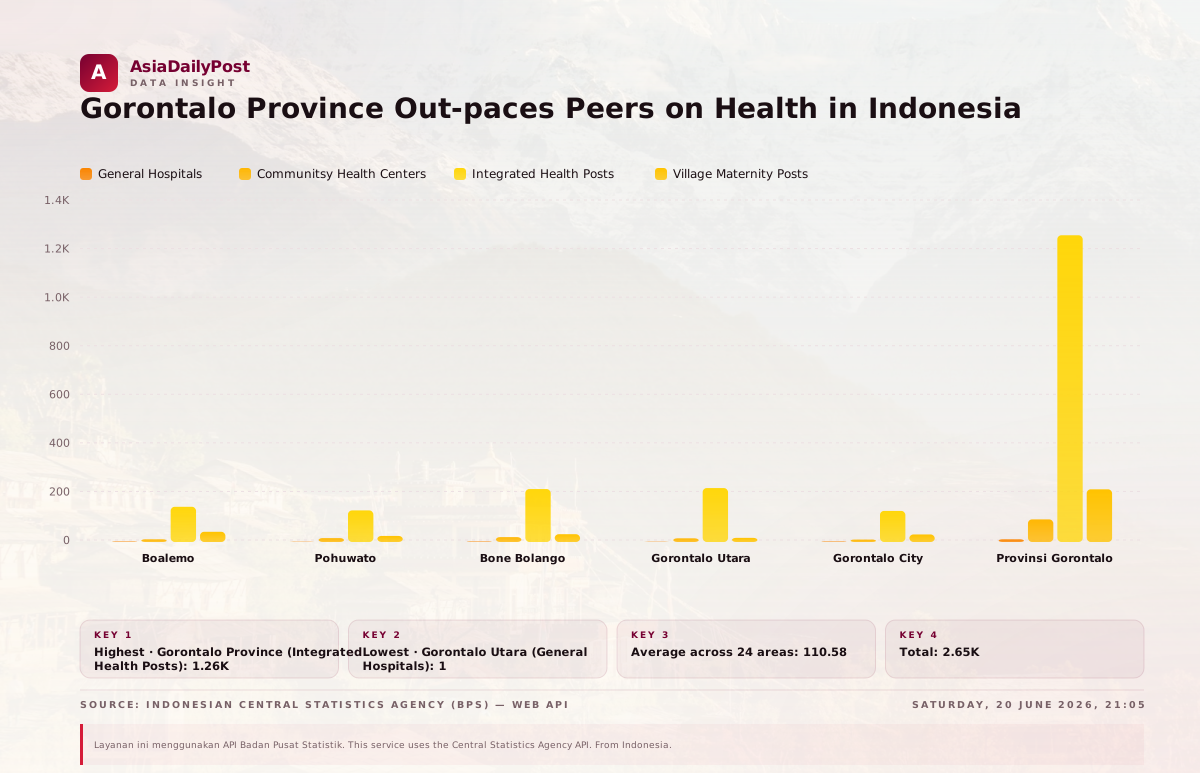
Fresh 2020 data published by Indonesian Central Statistics Agency (BPS) — Web API reveal a wide span in health across Gorontalo's 24 administrative units. Gorontalo Province leads the table with 1.26K (Integrated Health Posts), a level that comfortably outpaces both the provincial average and the next-ranked districts. By contrast, Gorontalo Utara registers the lowest reading at 1 (General Hospitals), underscoring the uneven spatial pattern of health within the province.
The gap between the top and bottom of the rankings stands at 1.26K — a ratio of roughly 1263.0 to one between Gorontalo Province and Gorontalo Utara. Analysts describe such a spread as stark, reflecting how local conditions, demographics and policy implementation can produce highly varied outcomes across geographically proximate areas.
The next tier of high performers comprises Gorontalo Utara at 222 and Bone Bolango at 218, both of which clear the provincial average by a comfortable margin. Reading the rankings from the top, the picture is consistent: Provinsi Gorontalo (1.26K (Integrated Health Posts)), Gorontalo Utara (222 (Integrated Health Posts)), Bone Bolango (218 (Integrated Health Posts)) form a band of leading districts whose figures sit well above the Gorontalo mean.
Summed across Gorontalo, the figures produce an average of 110.58 per district and a combined total of 2.65K. The mean provides a useful yardstick: Gorontalo Province's reading is 1042.1% above that benchmark, while Gorontalo Utara comes in 99.1% below it.
Set against Indonesia's national picture, the Gorontalo figures reflect dynamics observed across much of the country: a concentration of higher readings in urbanised districts, and persistently lower values in less-densely populated or more remote areas. While the spread documented in the 2020 data is consistent with previous reporting cycles, the persistence of the gap underscores the difficulty of producing rapid convergence in health through standard policy levers alone.
Among the lowest-ranked districts, Gorontalo Utara (1 (General Hospitals)), Pohuwato (1 (General Hospitals)), Gorontalo City (2 (General Hospitals)) stand out, with figures that lag the provincial benchmark by meaningful margins. The pattern echoes longer-running trends in Indonesia's regional statistics, where smaller and more remote administrative units have repeatedly registered weaker readings on a range of socio-economic indicators.
The figures are compiled by Indonesian Central Statistics Agency (BPS) — Web API as part of its routine reporting on health indicators at the subnational level. The dataset for Gorontalo (Gorontalo) covers all 24 of the province's regencies and cities, with values referenced to the 2020 reporting year.
Looking ahead, the 2020 readings establish a clear baseline for tracking how health evolves in Gorontalo over the coming years. Closing the gap between the leading and trailing districts is widely seen as one of the more pressing tasks for both provincial authorities and the national agencies that allocate resources across Indonesia's subnational units.
Source: Indonesian Central Statistics Agency (BPS) — Web API · Saturday, 20 June 2026, 21:05