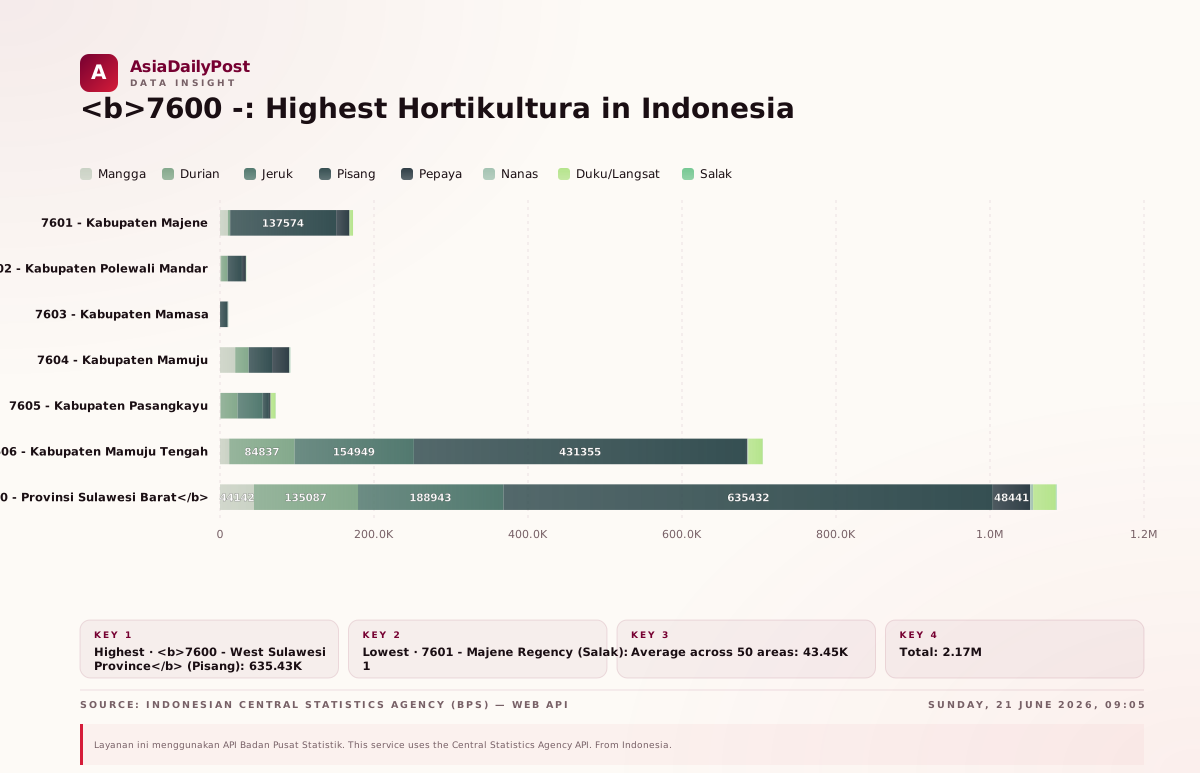
A new compilation of hortikultura data by Indonesian Central Statistics Agency (BPS) — Web API places 7600 - West Sulawesi Province at the forefront of West Sulawesi, with a figure of 635.43K quintals (Pisang) for 2021. The reading is the highest across the province's 50 regencies and cities, and stands in stark contrast to 7601 - Majene Regency, which posts the bottom value at 1 quintals (Salak). The disparity points to deep-seated structural differences in how the indicator unfolds locally.
That headline disparity of 635.43K quintals between 7600 - West Sulawesi Province and 7601 - Majene Regency is described as stark in scale, with the leading area posting a reading roughly 635432.0 times that of the bottom-ranked locality. The figures bring into sharp relief the policy challenge of narrowing intra-provincial gaps in hortikultura.
Behind 7600 - Provinsi Sulawesi Barat, the 2nd and 3rd positions go to 7606 - Kabupaten Mamuju Tengah with 431.36K quintals and 7600 - Provinsi Sulawesi Barat with 188.94K quintals. Together, the top three areas — <b>7600 - Provinsi Sulawesi Barat</b> (635.43K quintals (Pisang)), 7606 - Kabupaten Mamuju Tengah (431.36K quintals (Pisang)), <b>7600 - Provinsi Sulawesi Barat</b> (188.94K quintals (Jeruk)) — account for a disproportionate share of the upper distribution, reinforcing the picture of a leading cluster pulling ahead of the rest of the province.
Aggregating across the 50 regions yields an average of 43.45K quintals per district and a combined total of 2.17M quintals for 2021, offering a baseline against which individual readings can be compared. By that measure, 7600 - West Sulawesi Province's reading is roughly 1362.4% above the provincial mean, while 7601 - Majene Regency sits about 100.0% below it.
The latest readings build on a multi-year series tracking hortikultura across West Sulawesi. Comparable datasets in past years have shown that the leading districts tend to retain their advantage, while catch-up among the lower-ranked areas typically unfolds slowly. The 2021 numbers thus serve less as a one-off snapshot than as part of a longer arc, with most analysts cautioning that meaningful convergence in hortikultura at the regency level requires sustained investment and coordinated policy over several reporting cycles.
The bottom of the table is occupied by 7601 - Kabupaten Majene (1 quintals (Salak)), 7603 - Kabupaten Mamasa (90 quintals (Durian)), 7602 - Kabupaten Polewali Mandar (126 quintals (Duku/Langsat)), all of which fall below the West Sulawesi average. Such concentrations of lower readings are often associated with factors including remoteness, smaller population bases, and historically lower access to public services. Closing the gap with leading districts has been a recurring theme in provincial development plans.
Data are sourced from Indonesian Central Statistics Agency (BPS) — Web API and form part of an ongoing series tracking agriculture conditions across Indonesia. For West Sulawesi, the 2021 release includes readings for each of the 50 regencies and cities under the province's administrative purview.
The broader picture that emerges from the data is one of meaningful intra-provincial variation in hortikultura, a feature that mirrors patterns documented elsewhere in Indonesia. Whether the gap narrows over the next reporting cycles will depend on the success of targeted programmes aimed at strengthening the position of the weaker-performing districts in West Sulawesi.
Source: Indonesian Central Statistics Agency (BPS) — Web API · Sunday, 21 June 2026, 09:05