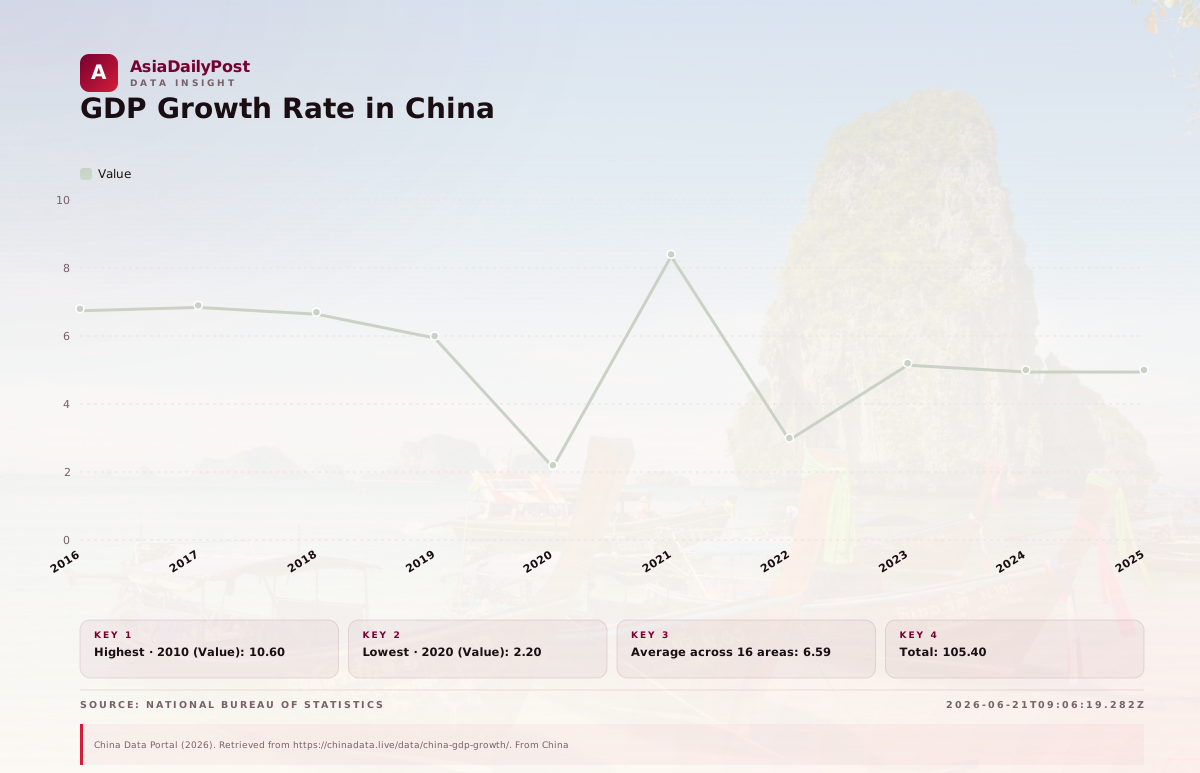
A new compilation of economics data by National Bureau of Statistics places 2010 at the forefront of China, with a figure of 10.60 (Value) for 2026. The reading is the highest across the province's 16 regencies and cities, and stands in stark contrast to 2020, which posts the bottom value at 2.20 (Value). The disparity points to deep-seated structural differences in how the indicator unfolds locally.
Taken together, the highest and lowest readings differ by 8.40, equivalent to a 4.8-fold gap. The variation, which observers consider meaningful, illustrates the degree to which economics hinges on factors ranging from urban density and infrastructure to historical access to public services.
Aggregating across the 16 regions yields an average of 6.59 per district and a combined total of 105.40 for 2026, offering a baseline against which individual readings can be compared. By that measure, 2010's reading is roughly 60.9% above the provincial mean, while 2020 sits about 66.6% below it.
Set against China's national picture, the China figures reflect dynamics observed across much of the country: a concentration of higher readings in urbanised districts, and persistently lower values in less-densely populated or more remote areas. While the spread documented in the 2026 data is consistent with previous reporting cycles, the persistence of the gap underscores the difficulty of producing rapid convergence in economics through standard policy levers alone.
The figures are compiled by National Bureau of Statistics as part of its routine reporting on social and economic indicators at the subnational level. The dataset for China covers all 16 of the province's regencies and cities, with values referenced to the 2026 reporting year.
Looking ahead, the 2026 readings establish a clear baseline for tracking how economics evolves in China over the coming years. Closing the gap between the leading and trailing districts is widely seen as one of the more pressing tasks for both provincial authorities and the national agencies that allocate resources across China's subnational units.
Source: National Bureau of Statistics · 2026-06-21T09:06:19.282Z