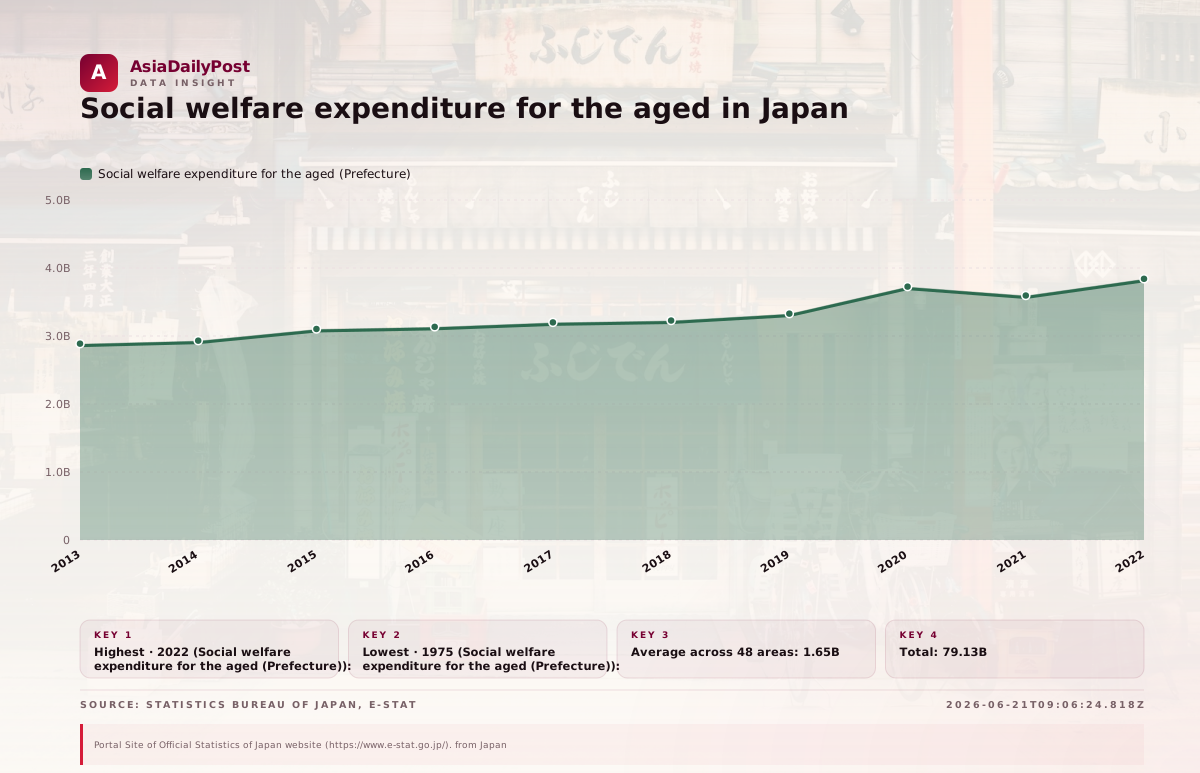
Fresh 2026 data published by Statistics Bureau of Japan, e-Stat reveal a wide span in social across Japan's 48 administrative units. 2022 leads the table with 3.84B (Social welfare expenditure for the aged (Prefecture)), a level that comfortably outpaces both the provincial average and the next-ranked districts. By contrast, 1975 registers the lowest reading at 167.04M (Social welfare expenditure for the aged (Prefecture)), underscoring the uneven spatial pattern of social within the province.
That headline disparity of 3.67B between 2022 and 1975 is described as stark in scale, with the leading area posting a reading roughly 23.0 times that of the bottom-ranked locality. The figures bring into sharp relief the policy challenge of narrowing intra-provincial gaps in social.
Aggregating across the 48 regions yields an average of 1.65B per district and a combined total of 79.13B for 2026, offering a baseline against which individual readings can be compared. By that measure, 2022's reading is roughly 133.0% above the provincial mean, while 1975 sits about 89.9% below it.
Beyond the 2026 headline figures, the data take on additional weight when viewed against Japan's broader development indicators. Regional disparities in social of this magnitude are far from unique to Japan: similar patterns recur across several provinces, where urban centres consistently outperform rural and remote districts. The challenge for policymakers is to translate the diagnostic value of these readings into targeted programmes capable of nudging the laggards closer to the leading districts over time.
Statistics Bureau of Japan, e-Stat publishes the indicators on a recurring basis as part of broader monitoring of regional development. The 2026 snapshot for Japan captures all 48 subordinate jurisdictions and provides a comparable view across the province's diverse local economies.
The broader picture that emerges from the data is one of meaningful intra-provincial variation in social, a feature that mirrors patterns documented elsewhere in Japan. Whether the gap narrows over the next reporting cycles will depend on the success of targeted programmes aimed at strengthening the position of the weaker-performing districts in Japan.
Source: Statistics Bureau of Japan, e-Stat · 2026-06-21T09:06:24.818Z