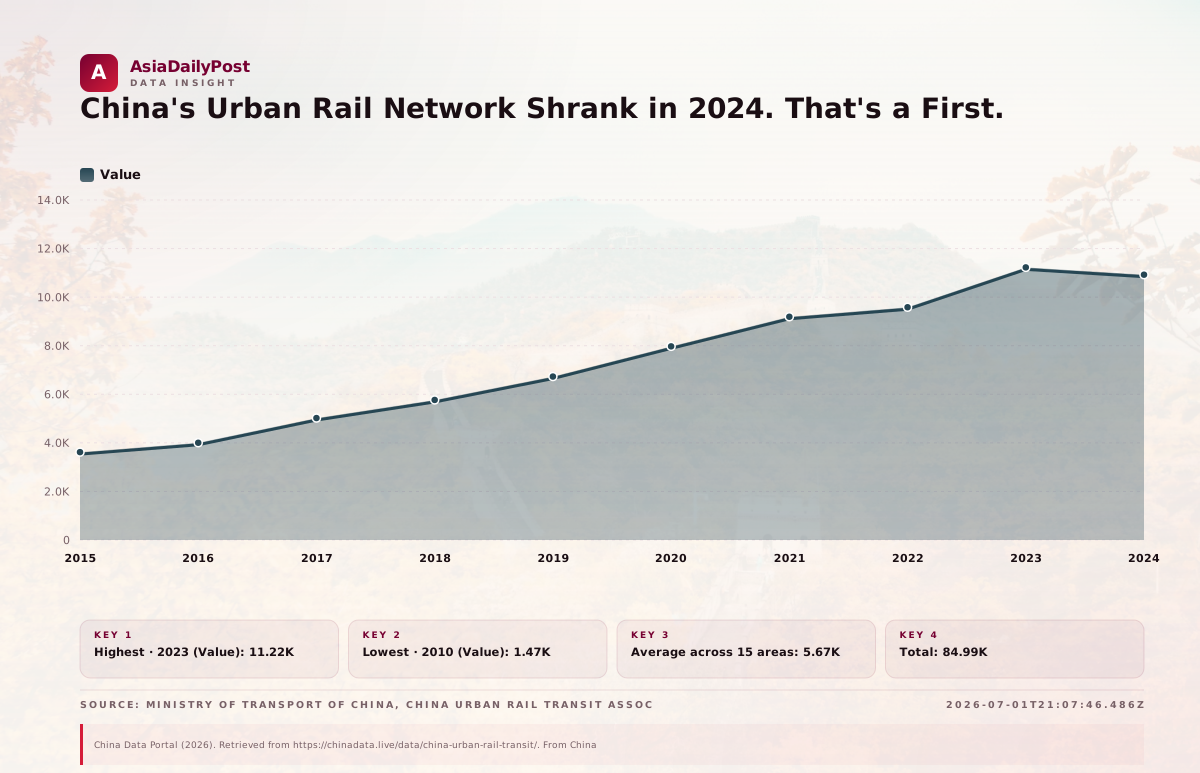
For the better part of fifteen years, China’s urban rail network seemed to obey a single rule: bigger every year. New lines opened in second-tier cities almost monthly, turning what was once a Beijing-and-Shanghai story into a nationwide infrastructure binge. That relentless upward trajectory reshaped commute times, property values, and the physical footprint of dozens of cities. Then 2024 arrived, and the curve bent.
The arc of expansion
The numbers are staggering. In 2010, tracked urban rail mileage stood at 1,469 km. By 2024, the figure had ballooned to 10,924 km, according to data from the Ministry of Transport and the China Urban Rail Transit Association compiled by China Data Live. That still represents a more than sevenfold increase and gives the country a network that surpasses the combined total of the next ten largest metro systems. But the 2024 reading is down from the 2023 peak of 11,225 km, marking the first year-on-year contraction in the series.
The first blemish in a perfect growth chart
The 2023 peak of 11,225 km was the highest on record, capping a run of 14 consecutive annual increases. The 2024 dip—a decline of 301 km—is small in percentage terms, about 2.7%, but it fractures a streak that defined the world’s most ambitious urban infrastructure program.
A rounding error with real symbolic weight
In a network that covers more distance than the Earth’s diameter, a 301 km drop can be dismissed as a statistical flicker. Yet the interruption lands at a moment when Beijing is tightening fiscal discipline on local governments, the primary funders of subway and light-rail projects. After years of warnings about unprofitable lines and ballooning debt, the data provides a rare tangible hint that the era of unconditional metro expansion may be ending.
- Total mileage grew from 1,469 km to 10,924 km, a 7.4-fold increase in 14 years.
- The network added an average of roughly 675 km per year over that span.
- 2023 alone saw over 1,600 km of new track enter operation, the largest annual jump.
- The modest pullback in 2024 aligns with a government clampdown on infrastructure spending that began in 2023.
Whether 2024 proves to be a one-off plateau or the start of a flatter trajectory is an open question. With urban populations still swelling and car ownership rising, pressure to expand rail networks will not disappear. But the era of no-questions-asked metro construction may have quietly come to a close, forcing cities to lean harder on buses, bikes, and better management of the track they already have.
Source: Ministry of Transport of China, China Urban Rail Transit Association · 2026-07-01T21:07:46.486Z