On paper, China's 2025 GDP figure — $19.6 trillion in current dollars — looks like more of the same relentless march upward that defined the past four decades. But the story the World Bank's 66-year data set tells is not one of uninterrupted acceleration. It's a tale of a superpower hitting the limits of the growth model that got it there.
How did China's economy rise from near-zero to nearly $20 trillion?
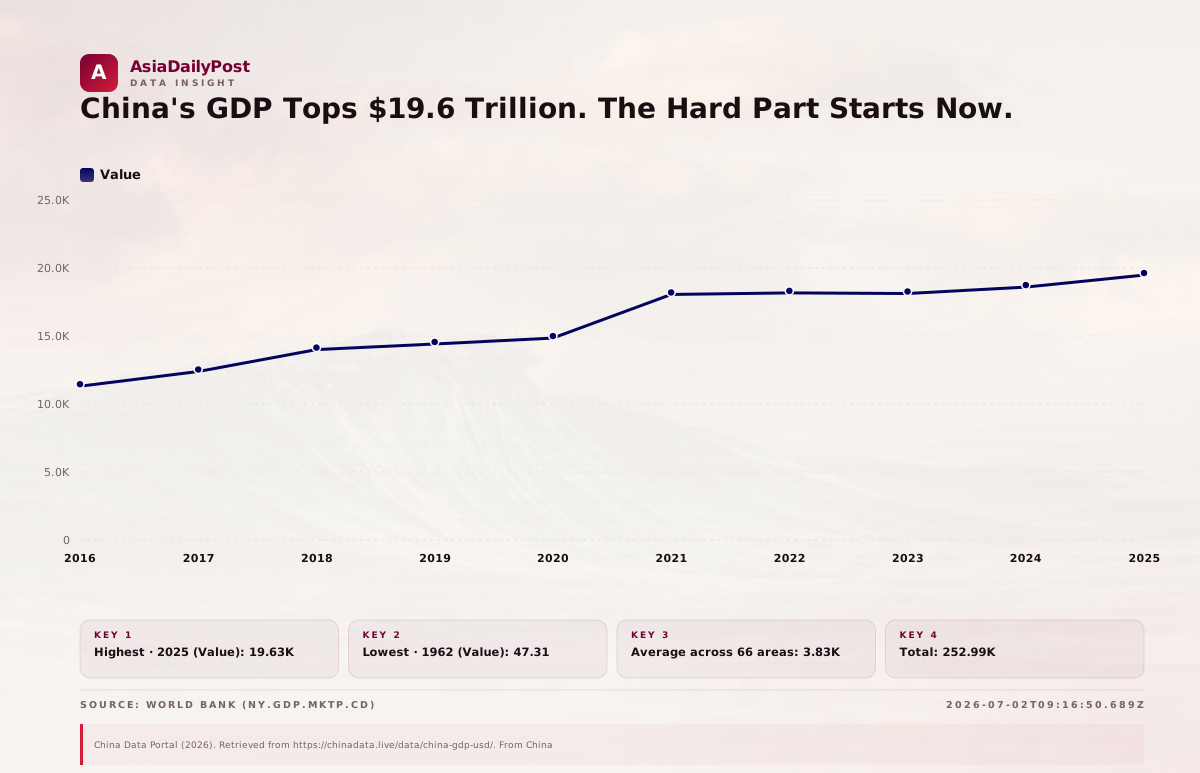
In 1962, when the data begins, China's GDP stood at $47.3 billion. It would cross the $1 trillion threshold only in 1998, after 36 years. The real transformation, however, came after 2000. The economy added another $9 trillion by 2014, then kept climbing — through the global financial crisis, through a pandemic — to hit $19,628 billion in 2025, a roughly 415‑fold increase from that 1962 low.
Where did the post-pandemic momentum stall?
The 2020 shock dropped output to $14,996 billion, but the bounce-back was swift. Yet by 2023, the figure barely budged — $18,270 billion, essentially flat from 2022's $18,317 billion. The 2024‑2025 pickup to $19,628 billion represents a gain of about $880 billion, a pace that, while still among the world's fastest, is far below the trillion-dollar annual leaps of the early 2010s.
What does this mean for China's race with the United States?
Nominal GDP in dollars doesn't tell the whole story of economic power, but markets and policymakers track it obsessively. At $19.6 trillion, China remains the world's clear second-largest economy. However, the US economy — last estimated at around $27.5 trillion in 2023 — has been widening the gap in current-dollar terms as China's growth rate settles into the 4–5% range. Catching up now requires not just speed, but sustained domestic demand that Beijing has struggled to generate.
- From $47 billion in 1962 to $1 trillion in 1998: 36 years of grinding industrial buildup.
- The next $9 trillion came in 16 years, breaching $10.7 trillion in 2014, powered by export-led manufacturing.
- Adding another $4.6 trillion from the pandemic trough to 2025 took only five years — but the annual gains are shrinking even in boom times.
The decade ahead will test whether a maturing China can find new engines beyond construction and credit. The 2025 high-water mark offers no guarantee of another — just a reminder that economic gravity, once deferred, eventually demands to be paid.
Source: World Bank (NY.GDP.MKTP.CD) · 2026-07-02T09:16:50.689Z