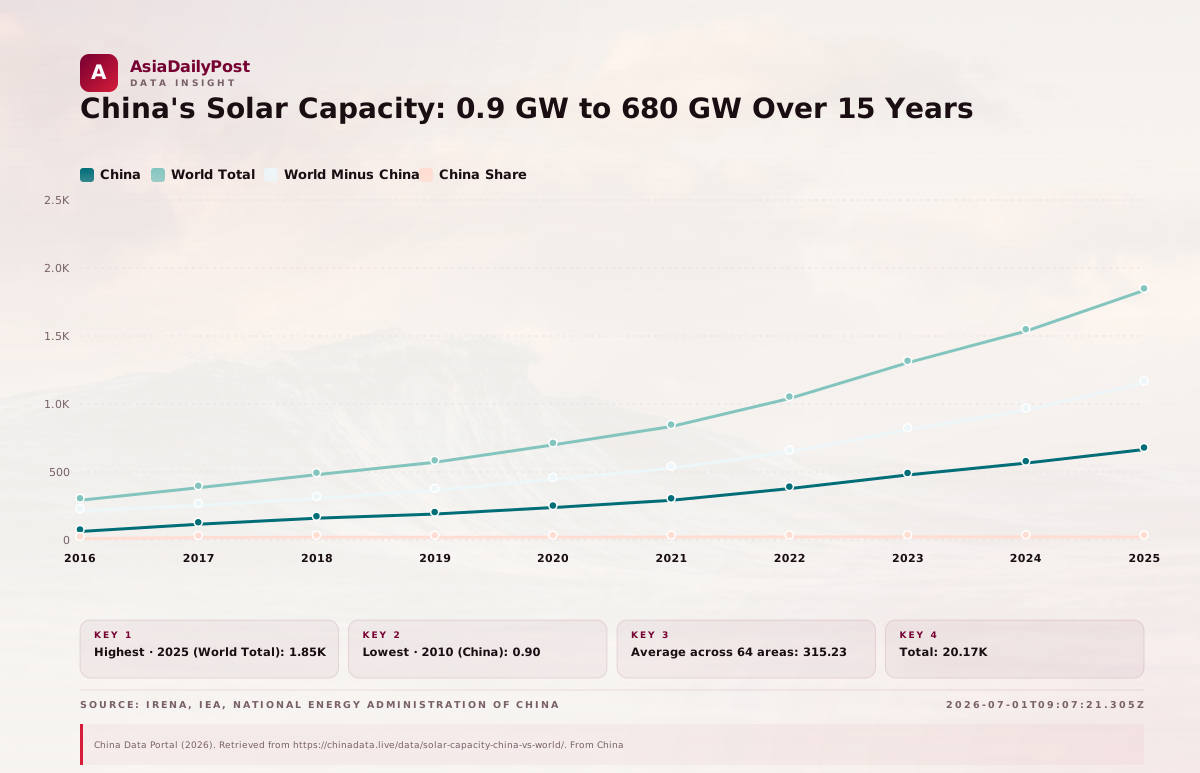
China's solar photovoltaic journey from 2010 to 2025 spans both the dataset's low point — 0.9 GW of installed capacity in China itself — and its high point, a global total of 1,850 GW in 2025, according to figures compiled by IRENA and the National Energy Administration.
Top of the chart: 1,850 GW world total in 2025
The 2025 global solar PV fleet reached 1,850 GW, more than doubling the 714 GW recorded just five years earlier. China accounted for 680 GW of that, or 36.8%, while the rest of the world added 1,170 GW. The gap between China and the rest of the world continued to narrow in percentage terms, however, as installations spread rapidly across India, Europe, and the United States.
The other end: 0.9 GW in China, 2010
In 2010, China's solar PV capacity was a negligible 0.9 GW, representing just 2.3% of the world's 40 GW. At the time, Germany, Spain, and Japan dominated the global ranking. A Chinese energy planner looking at that number would have seen a sector that contributed almost nothing to power generation, relying almost entirely on imported polysilicon and cells.
What separates the two
The 15-year chasm was bridged by a combination of aggressive feed-in tariffs, massive domestic manufacturing scale-up, and plunging module costs that made solar the cheapest new electricity source in most markets. China's annual additions began to accelerate sharply after 2013, and by 2017 it had already claimed the largest installed base. The data implies that policy certainty and industrial strategy, as much as solar resource quality, drove the transformation.
- 2010: 0.9 GW
- 2011: 3.1 GW
- 2015: 43.5 GW
- 2018: 175 GW
- 2020: 253.4 GW
- 2023: 493 GW
- 2025: 680 GW
The trajectory flattens only slightly in 2024 and 2025, suggesting the Chinese market has matured but is still adding capacity at a pace that far exceeds that of the rest of the world combined in earlier years.
Source: IRENA, IEA, National Energy Administration of China · 2026-07-01T09:07:21.305Z