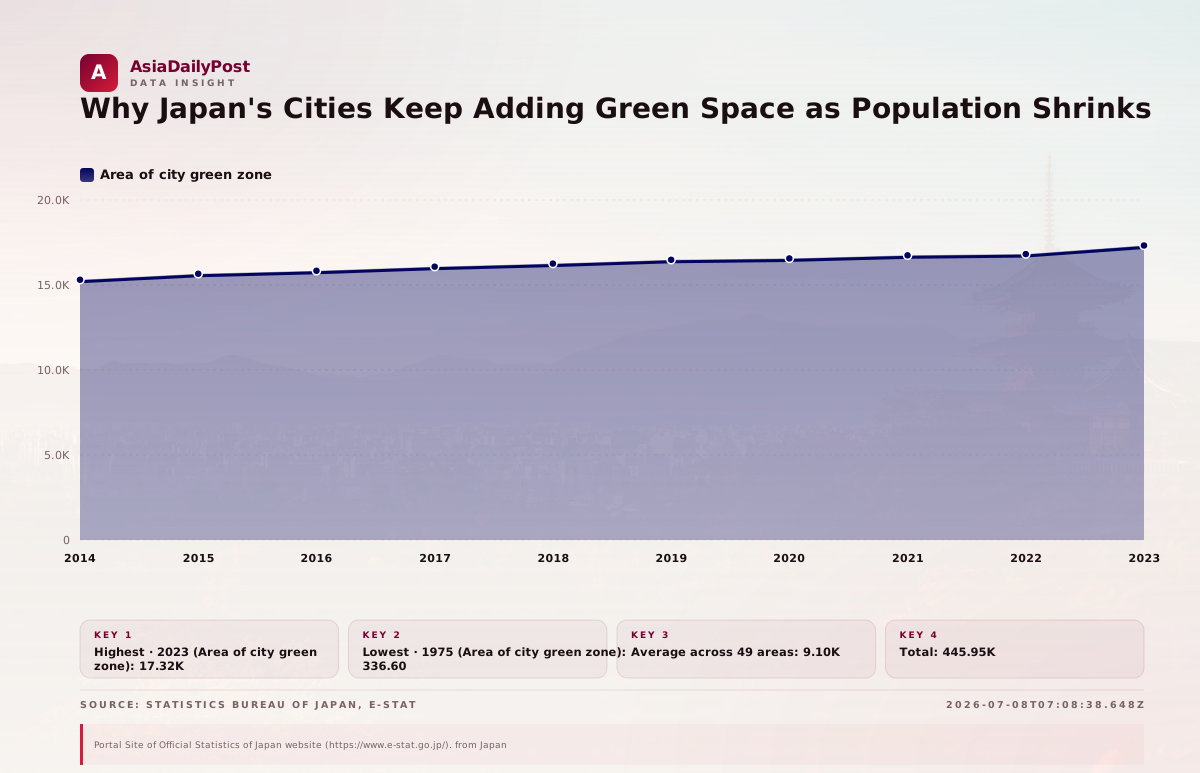
At a time when Japan's shrinking population forces entire neighbourhoods to consolidate, one feature of urban life is quietly expanding: green zones. In 1975, just 336.6 hectares of Japanese urban land fell under the city green zone designation. By 2023, that number had swelled to 17,324 hectares, a fifty-fold expansion, according to Statistics Bureau of Japan data.
Urban planners kept carving out green space through every cycle
The trajectory is almost linear. After a slow start — only 626 ha in 1977 — the area crossed 1,000 ha in the early 1980s. By 1990, it reached 5,283 ha, then kept climbing even as the post-bubble economy stalled. From 1990 to 2010, the tally more than doubled to 14,039 ha.
The green footprint was remarkably insulated from economic shocks. During the 2008 financial crisis and the pandemic, annual additions never reversed; the only question was how fast it grew. The slowest growth years still added over 100 ha, while bumper years added 700–800 ha.
Shrinking population didn't reverse the trend—it may have accelerated it
Between 2020 and 2023, as Japan's total population fell by about 1.5 million, city green zones expanded by 840 hectares. That's one of the largest three-year jumps in the 49-year series. Vacant schoolyards, derelict factory sites, and coastal land increasingly got reclassified as green space rather than being kept for residential or commercial use.
Local governments, facing shrinking tax bases and pressure to improve liveability, seem to be seizing the opportunity. The environmental angle matters, but so does the cheapness of maintaining a park versus a housing block that won't be filled. The data suggests a quiet choice being made across hundreds of municipalities.
Whether this expansion reflects an intentional green-shift or simply a land-banking exercise is a question the numbers can't answer. But the trend is unmistakable: Japan is adding far more green space to its cities than at any point in its history, even as the reasons to pour concrete fade.
Source: Statistics Bureau of Japan, e-Stat · 2026-07-08T07:08:38.648Z