Singapore’s restaurant industry has spent half a decade waiting for a recovery that official figures show still hasn’t come. Even as diners crowd hawker centres and fast-food chains post record volumes, full-service restaurants remain stuck stubbornly below their 2017 baseline, according to the latest food and beverage services index.
Why hasn't restaurant activity regained its pre-COVID level?
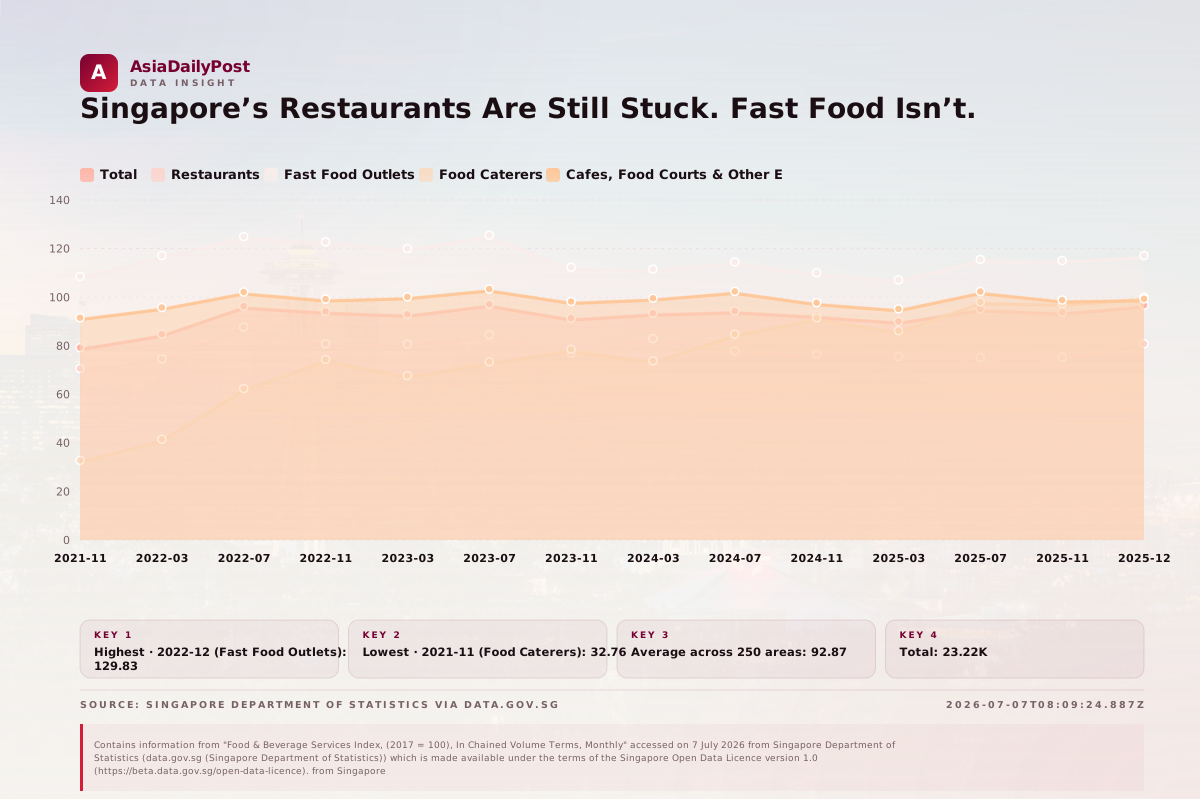
The monthly restaurant index briefly touched 97.5 in December 2021—just shy of the 100 baseline—but never broke through. In the years since, the figure has averaged in the low 80s, dipping as low as 69.1 in September 2025. December 2025 closed at 80.8, underscoring a persistent volume deficit that suggests a permanent recalibration rather than a temporary dip. The old lunch crowd hasn't fully returned, and nightlife spending patterns have shifted.
Which segment has outperformed the most?
Fast-food outlets have been the standout. Their index hit an all-time high of 129.8 in December 2022 and consistently stayed above 110. Even the latest reading of 117.1 leaves the category roughly 17% above 2017 volumes, suggesting consumers gravitated toward convenience and value—trends that intensified during the inflation years.
How does the rest of the industry compare?
The split goes beyond restaurants versus fast food. Cafés, food courts and other eating places tracked fairly close to the baseline, ending 2025 at 99.3, while food caterers posted the most dramatic rebound—from a rock-bottom 32.8 in November 2021 to 99.9 in December 2025. That near-tripling shows corporate and event catering clawed back once gatherings resumed. But the divergence between sit-down dining and the rest of the sector remains sharp.
- The restaurant index ended 2025 below every other sub-category except during the earliest pandemic months.
- Fast-food volumes remained 15-20% above baseline for much of the period, while restaurants never exceeded the baseline.
- Food caterers surged from roughly one-third of baseline in late 2021 to nearly 100 by end-2025.
The question for policymakers and landlords isn't whether diners are spending—they clearly are—but where. If restaurant volumes remain depressed even as the city returns to full activity, the industry's footprint may need to shrink permanently, with implications for retail rents and labour demand.
Source: Singapore Department of Statistics via data.gov.sg · 2026-07-07T08:09:24.887Z