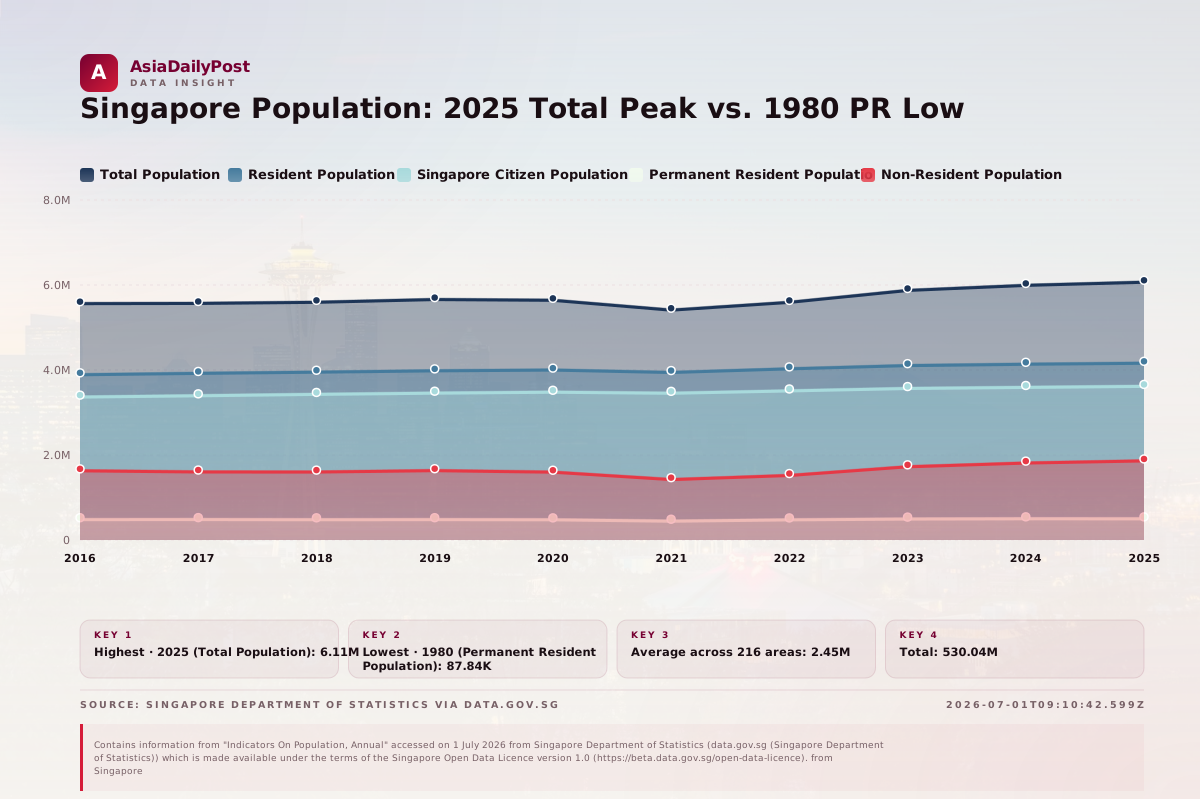
Singapore's population dataset, covering 1976 to 2025, lays bare a vast numerical spectrum: the highest recorded value is 6,111,175 total population in 2025, while the lowest is a mere 87,845 permanent residents in 1980 — a gap of more than six million that spans categories and decades.
Top of the chart: Total Population in 2025
The 2025 total population figure of 6,111,175 is the largest single entry across all indicators and years. It caps a near-unbroken climb from 2.29 million in 1976, with the only dips occurring in 1986 and 2020—the latter a marginal decline of about 22,000 during the pandemic year. The dataset's top ranks are monopolised by total population statistics from recent years: 2024 at 6.04 million, 2023 at 5.92 million, and a pre-pandemic high of 5.70 million in 2019. This clustering confirms that Singapore's demographic expansion has been sustained and, by the mid-2020s, pushed the overall headcount firmly past the six-million mark for the first time.
The other end: Permanent Resident Population in 1980
At the opposite extreme sits the 87,845 permanent residents recorded in 1980, the smallest non-null value in the entire series. Permanent resident data only appears from 1980 onward—earlier years show no entries—and that inaugural figure represented less than 4% of the total population at the time. The number captures a period when Singapore's PR framework was far narrower, with foreign talent and long-term residency pathways yet to expand. Since then, the PR population has multiplied more than six-fold, reaching 543,832 in 2025, though it remains a fraction of the citizen base, which stood at 3.66 million that same year.
What separates the two
The cavernous distance between 6.11 million and 87,845 is not simply a matter of population growth—it reflects entirely different population categories. Total population aggregates citizens, permanent residents, and non-residents (foreign workers, students, and dependents), which together constitute the full de facto population. The 2025 total includes some 1.9 million non-residents and 4.2 million residents, showing how labour inflows and immigration drive the headline number. In contrast, the 1980 permanent resident count was a tightly controlled subset, with non-resident numbers also low at just 131,820. The gap thus underscores Singapore's transformation from a society with minimal foreign presence to a global hub where non-citizens make up a substantial share of the population.
- Total Population 2025: 6,111,175
- Total Population 2024: 6,036,860
- Total Population 2023: 5,917,648
- Total Population 2019: 5,703,569
- Total Population 2020: 5,685,807
- Total Population 2018: 5,638,676
- Total Population 2022: 5,637,022
While the decades-long climb to the six-million milestone dominates the dataset's upper ranks, the 1980 permanent resident low—only 87,845—provides a historical baseline that puts today's half-million PR figures into sharp relief. Across categories and years, the numbers tell a story of a nation that has systematically expanded its demographic boundaries.
Source: Singapore Department of Statistics via data.gov.sg · 2026-07-01T09:10:42.599Z