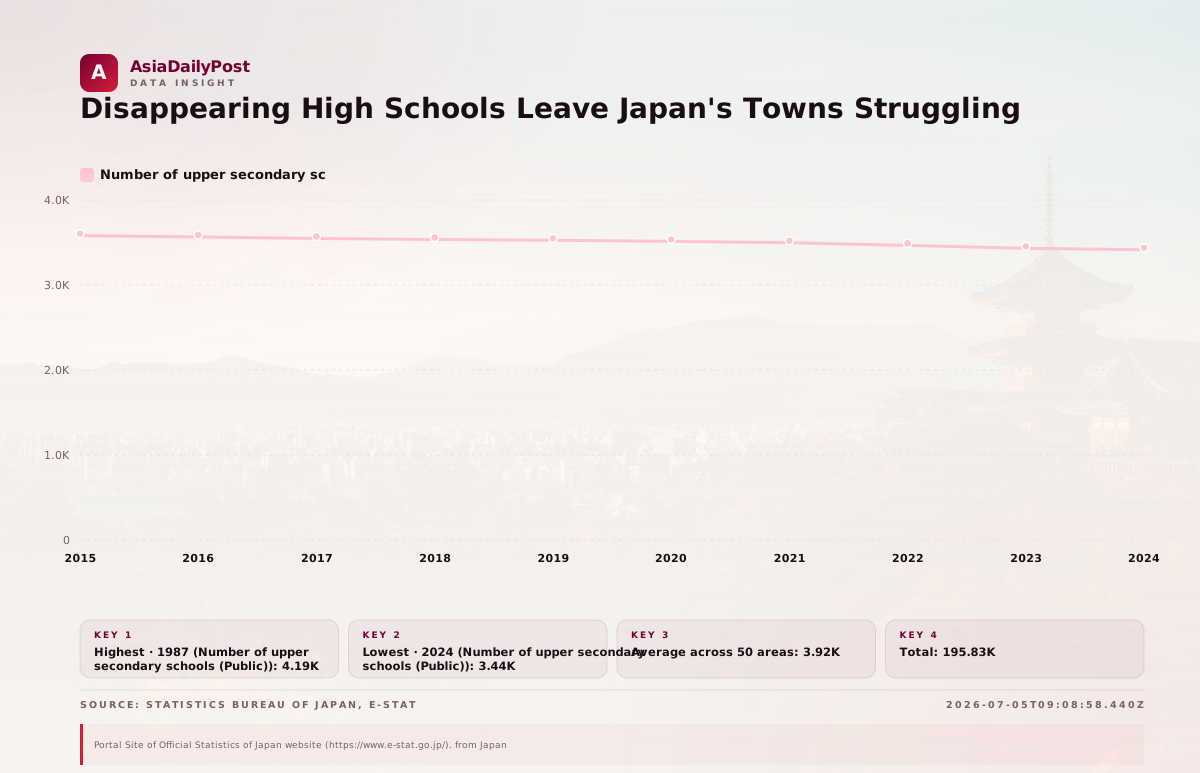
Japan counted 3,438 public upper secondary schools in 2024, the fewest since records began in 1975, as the nation's demographic crunch forces a steady cull of campuses. The figure, released by the Statistics Bureau of Japan, represents an 18 percent retreat from the all-time high of 4,191 schools set in 1987.
The long descent
Government data show that in 1975, Japan counted 3,701 public upper secondary schools. The number climbed steadily, passing 3,900 by 1980 and peaking at 4,191 in 1987 — the tail end of the country's second postwar baby boom.
From there, the trajectory changed. The count plateaued near 4,160 through the 1990s, then began a persistent slide in 2002. By 2010 it had fallen below 3,800, and closures accelerated after 2015. The 2024 figure of 3,438 erases five decades of expansion, landing where Japan was in the mid-1970s. Over the full 50-year record, the average number of public high schools stood at roughly 3,917, well above current levels.
Where the pressure comes from
The slide closely tracks Japan's long-running fertility decline. The population aged 15–19 — the core high-school cohort — shrank from roughly 9 million in the early 1990s to about 5.5 million by 2024, deflating enrolment and making smaller schools impossible to sustain.
Consolidation in the classroom
Most closures hit regional and rural prefectures, where sparse school-age populations make standalone campuses unviable. Local governments merge several small high schools into a single larger institution, or transfer public facilities to private operators. The trend leaves behind empty school buildings and, in some communities, accelerates the hollowing-out of villages already fighting depopulation — a loss that goes beyond education budgets.
- Peak: 4,191 schools in 1987
- 2024 mark: 3,438 — the lowest in the 50-year series
- Total drop: 753 schools, or 18%
- Unbroken streak: Declined every year since 2002
With Japan's birthrate still falling and the student-age population projected to shrink by another tenth before 2030, the pressure on public high school numbers shows no sign of easing. The choices ahead — between preserving local identity and maintaining teaching standards — will define the educational landscape for years to come.
Source: Statistics Bureau of Japan, e-Stat · 2026-07-05T09:08:58.440Z