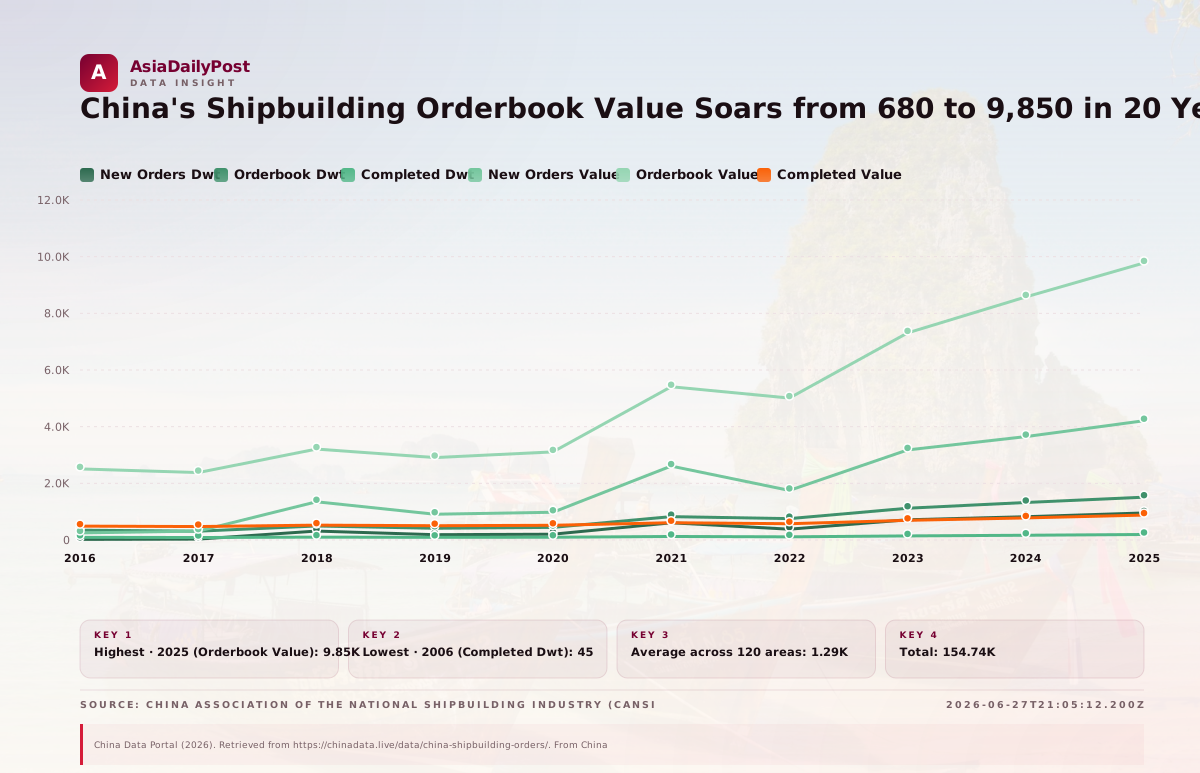
China’s shipbuilding orderbook value index started at 680 in 2006 and climbed to 9,850 by 2025, the highest point in two decades of CANSI data, while physical deadweight completions in 2006 were a mere 45 DWT — a gap that captures the industry’s vast expansion.
Top of the chart: 2025
The orderbook value index hit 9,850 in 2025, extending a rally that saw it breach 8,000 for the first time in 2024. This metric, a composite measure of contract value, was flanked by new-order value of 4,280 and completed-value of 950, while deadweight tonnage in the orderbook reached 1,582 DWT — all records. Shipyards entered 2026 with the heaviest backlog on record.
The other end: 2006
In 2006, the orderbook value index stood at just 680. New-order value was 215, and completed-value 145. Physical output was even starker: completed deadweight tonnage reached only 45 DWT, new orders 73 DWT, and the entire orderbook 104 DWT — figures that today reflect a single large container ship order. The gap between 2006 and 2025 is not merely numerical; it traces the arc of China’s emergence as the world’s dominant shipbuilder.
What separates the two eras
The fourteenfold increase in the orderbook value index reflects more than volume — it points to a shift toward high-value vessels such as LNG carriers and ultra-large container ships, alongside aggressive yard expansion and state-backed financing. The physical deadweight tonnage metrics, by contrast, grew by a factor of roughly five to six, underscoring a deliberate push up the value chain rather than pure tonnage accumulation.
- 2006: 680
- 2007: 1,050
- 2008: 2,340
- 2009: 3,620
- 2010: 6,850
- 2011: 6,420
- 2012: 4,150
- 2013: 3,850
- 2014: 4,850
- 2015: 3,450
- 2016: 2,580
- 2017: 2,450
- 2018: 3,280
- 2019: 2,980
- 2020: 3,180
- 2021: 5,480
- 2022: 5,080
- 2023: 7,380
- 2024: 8,650
- 2025: 9,850
The orderbook value index, despite occasional pullbacks during global shipping downturns, has more than tripled since the mid-2010s, leaving Chinese yards with a cushion of secured work that will take years to build through.
Source: China Association of the National Shipbuilding Industry (CANSI) · 2026-06-27T21:05:12.200Z