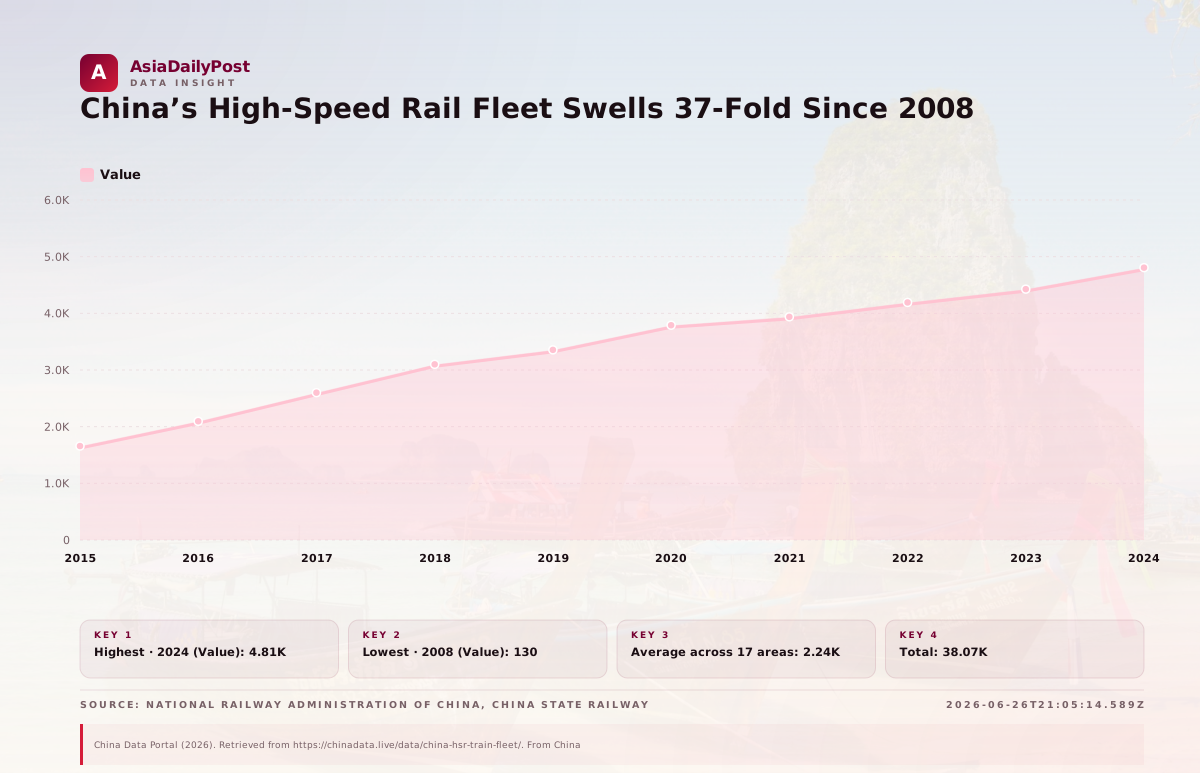
When the first high-speed line opened ahead of the 2008 Beijing Olympics, China’s fleet of electric multiple-unit train sets was little more than a proof-of-concept — just 130 standard EMU sets, mostly imported or license-built designs. Sixteen years later, the system has become the world’s largest and most intensely used network, carrying billions of passengers annually and reshaping the country’s economic geography.
Fleet growth in numbers
By the end of 2024, the operational fleet stood at 4,806 standard EMU train sets, according to the latest compilation from ChinaData Live. That figure represents a 37-fold increase from the 130 sets registered in 2008, equating to a net addition of roughly 292 sets each year. Assuming the widespread eight-car standard formation, the total railcar count soared to 38,448 — enough to form a single passenger train stretching from Beijing to Shanghai.
The acceleration that shaped the network
The expansion was far from linear. After a cautious start — the fleet had only 692 sets by 2012 — the pace quickened sharply. Between 2013 and 2018, the fleet more than tripled, surpassing 3,100 sets, driven by the rollout of new Fuxing and Hexie series trains on freshly opened corridors.
The post-pandemic trajectory and the road ahead
Growth did not stall during the pandemic years, even though annual additions softened from their mid-2010s peaks. The fleet expanded from 3,790 sets at the close of 2020 to 4,806 by 2024, still adding around 250 new sets per year. With 48,000 km of track now in operation — and a goal of 70,000 km by 2035 — the network’s hunger for rolling stock remains robust; CRRC’s production lines can deliver well over 400 sets annually.
- Over 1,200 Fuxing trainsets, capable of 350 km/h, were operating by 2024 — a sharp contrast to zero a decade earlier.
- Network length grew from a single line to 48,000 km, creating demand for a fleet that serves hundreds of cities.
- Annual purchases peaked at roughly 500 sets in 2017 and 2018, aligned with a wave of new trunk-route openings.
- Even during 2020–2022, China added more than 400 new sets, reflecting the government’s commitment to rail infrastructure.
The 17-year ascent from 130 to nearly 5,000 standard sets is more than a transport statistic; it mirrors China’s rapid urbanisation and its strategic bet on rail as the backbone of intercity mobility. As the network extends deeper into western regions, fleet growth is likely to continue as a bellwether of the country’s industrial and infrastructure ambitions.
Source: National Railway Administration of China, China State Railway Group · 2026-06-26T21:05:14.589Z