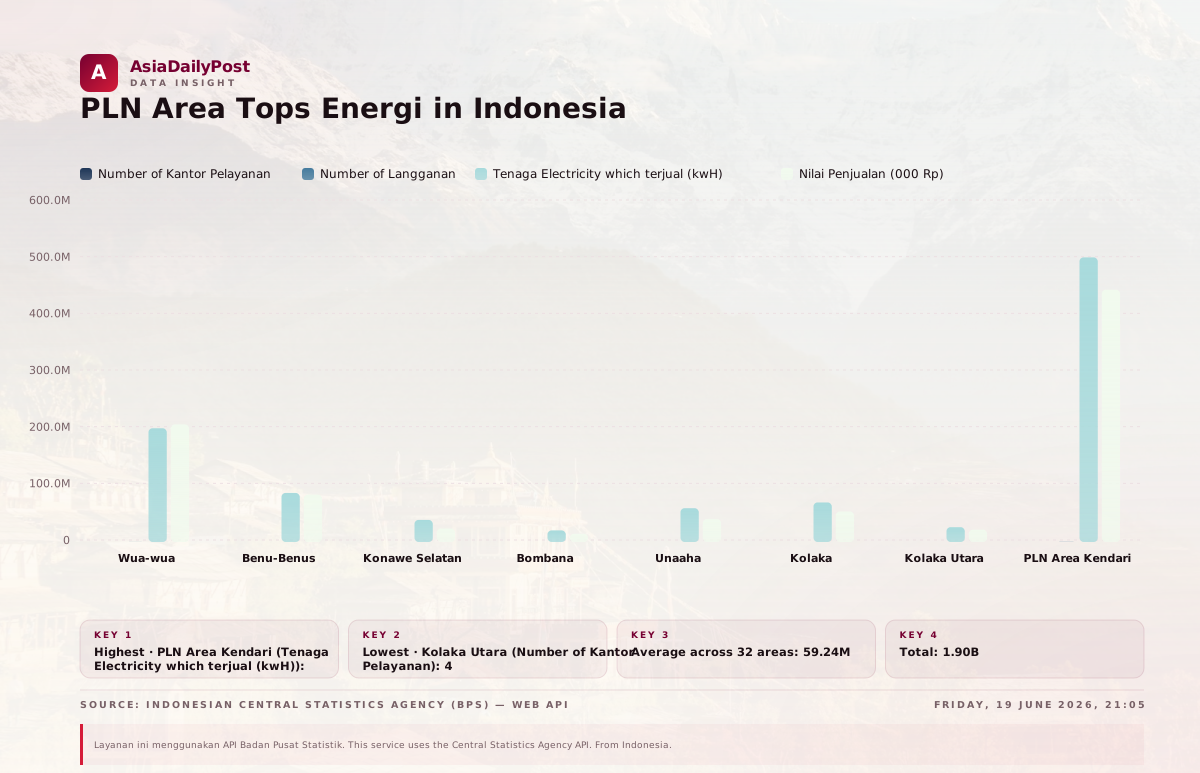
Southeast Sulawesi is showing notable disparities in energi across its 32 regencies and cities, according to the latest figures released by Indonesian Central Statistics Agency (BPS) — Web API. PLN Area Kendari tops the provincial ranking with a reading of 502.28M (Tenaga Electricity which terjual (kwH)), while Kolaka Utara sits at the other end of the scale with 4 (Number of Kantor Pelayanan). The findings, drawn from official 2014 data, offer a granular look at how this indicator plays out at the local level.
The gap between the top and bottom of the rankings stands at 502.28M — a ratio of roughly 125569549.3 to one between PLN Area Kendari and Kolaka Utara. Analysts describe such a spread as stark, reflecting how local conditions, demographics and policy implementation can produce highly varied outcomes across geographically proximate areas.
PLN Area Kendari (445.26M) and Wua-wua (207.49M) round out the top of the table, both posting readings that exceed the provincial average. The concentration of higher values in PLN Area Kendari (502.28M (Tenaga Electricity which terjual (kwH))), PLN Area Kendari (445.26M (Nilai Penjualan (000 Rp))), Wua-wua (207.49M (Nilai Penjualan (000 Rp))) signals that gains in energi have so far accrued to a relatively small group of districts within Southeast Sulawesi.
Combined, the 32 districts return an average of 59.24M per district and a combined total of 1.90B — a synthesis that helps put individual outliers in perspective. PLN Area Kendari clears the provincial mean by 747.9%, while Kolaka Utara undershoots it by 100.0%.
Beyond the 2014 headline figures, the data take on additional weight when viewed against Indonesia's broader development indicators. Regional disparities in energi of this magnitude are far from unique to Southeast Sulawesi: similar patterns recur across several provinces, where urban centres consistently outperform rural and remote districts. The challenge for policymakers is to translate the diagnostic value of these readings into targeted programmes capable of nudging the laggards closer to the leading districts over time.
The bottom of the table is occupied by Kolaka Utara (4 (Number of Kantor Pelayanan)), Bombana (4 (Number of Kantor Pelayanan)), Konawe Selatan (6 (Number of Kantor Pelayanan)), all of which fall below the Southeast Sulawesi average. Such concentrations of lower readings are often associated with factors including remoteness, smaller population bases, and historically lower access to public services. Closing the gap with leading districts has been a recurring theme in provincial development plans.
Indonesian Central Statistics Agency (BPS) — Web API publishes the indicators on a recurring basis as part of broader monitoring of regional development. The 2014 snapshot for Southeast Sulawesi captures all 32 subordinate jurisdictions and provides a comparable view across the province's diverse local economies.
The broader picture that emerges from the data is one of meaningful intra-provincial variation in energi, a feature that mirrors patterns documented elsewhere in Indonesia. Whether the gap narrows over the next reporting cycles will depend on the success of targeted programmes aimed at strengthening the position of the weaker-performing districts in Southeast Sulawesi.
Source: Indonesian Central Statistics Agency (BPS) — Web API · Friday, 19 June 2026, 21:05