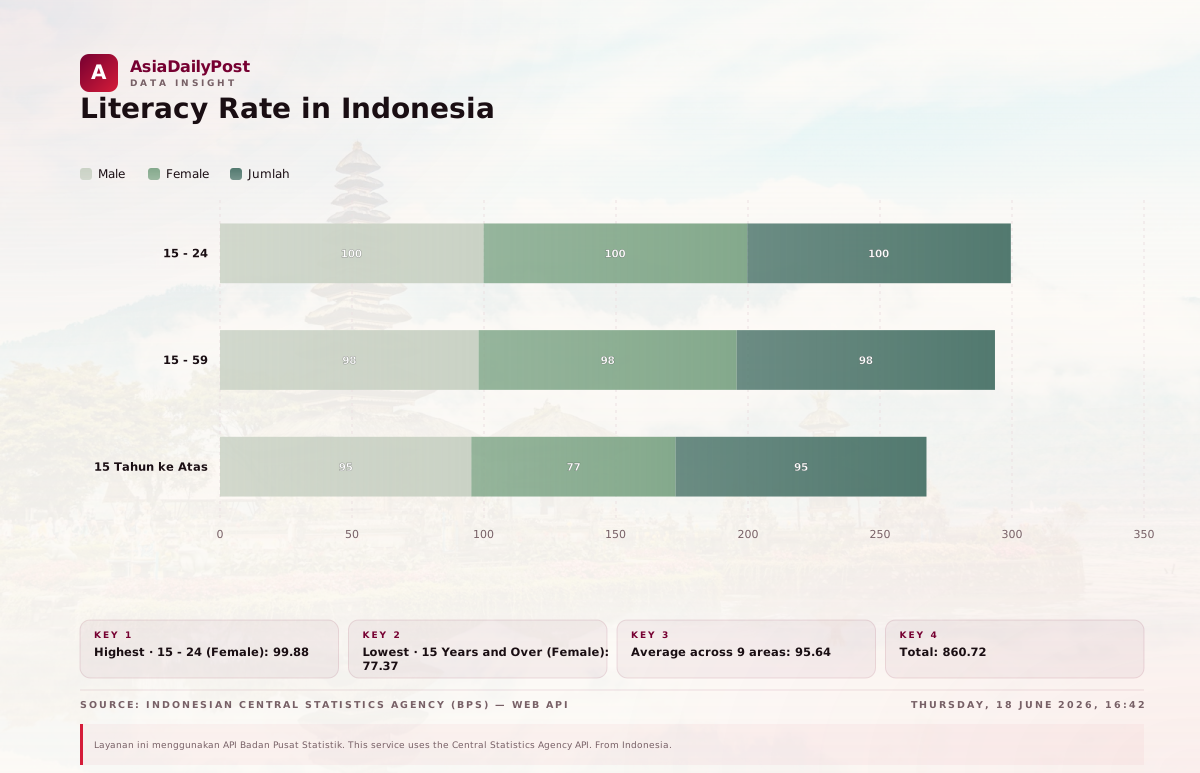
A new compilation of education data by Indonesian Central Statistics Agency (BPS) — Web API places 15 - 24 at the forefront of South Sulawesi, with a figure of 99.88 percent (Female) for 2025. The reading is the highest across the province's 9 regencies and cities, and stands in stark contrast to 15 Years and Over, which posts the bottom value at 77.37 percent (Female). The disparity points to deep-seated structural differences in how the indicator unfolds locally.
Taken together, the highest and lowest readings differ by 22.51 percent, equivalent to a 1.3-fold gap. The variation, which observers consider modest, illustrates the degree to which education hinges on factors ranging from urban density and infrastructure to historical access to public services.
15 - 24 (99.85 percent) and 15 - 24 (99.83 percent) round out the top of the table, both posting readings that exceed the provincial average. The concentration of higher values in 15 - 24 (99.88 percent (Female)), 15 - 24 (99.85 percent (Jumlah)), 15 - 24 (99.83 percent (Male)) signals that gains in education have so far accrued to a relatively small group of districts within South Sulawesi.
Combined, the 9 districts return an average of 95.64 percent per district and a combined total of 860.72 percent — a synthesis that helps put individual outliers in perspective. 15 - 24 clears the provincial mean by 4.4%, while 15 Years and Over undershoots it by 19.1%.
The latest readings build on a multi-year series tracking education across South Sulawesi. Comparable datasets in past years have shown that the leading districts tend to retain their advantage, while catch-up among the lower-ranked areas typically unfolds slowly. The 2025 numbers thus serve less as a one-off snapshot than as part of a longer arc, with most analysts cautioning that meaningful convergence in education at the regency level requires sustained investment and coordinated policy over several reporting cycles.
At the other end of the scale, 15 Tahun ke Atas (77.37 percent (Female)), 15 Tahun ke Atas (95.05 percent (Jumlah)), 15 Tahun ke Atas (95.19 percent (Male)) register among the lowest readings in South Sulawesi. The clustering of weaker figures in these districts highlights areas where targeted intervention may be required to lift outcomes closer to the provincial mean. Policymakers have previously flagged such pockets as priorities for capacity-building and resource allocation.
Data are sourced from Indonesian Central Statistics Agency (BPS) — Web API and form part of an ongoing series tracking education conditions across Indonesia. For South Sulawesi, the 2025 release includes readings for each of the 9 regencies and cities under the province's administrative purview.
Read in the round, the 2025 figures suggest that progress on education in South Sulawesi is uneven, with a handful of leading districts pulling ahead while several outlying areas continue to lag. Bridging that gap is likely to remain a central theme of provincial and national policy in the coming years, particularly as Indonesia pushes to harmonise development outcomes across its diverse regions.
Source: Indonesian Central Statistics Agency (BPS) — Web API · Thursday, 18 June 2026, 16:42